
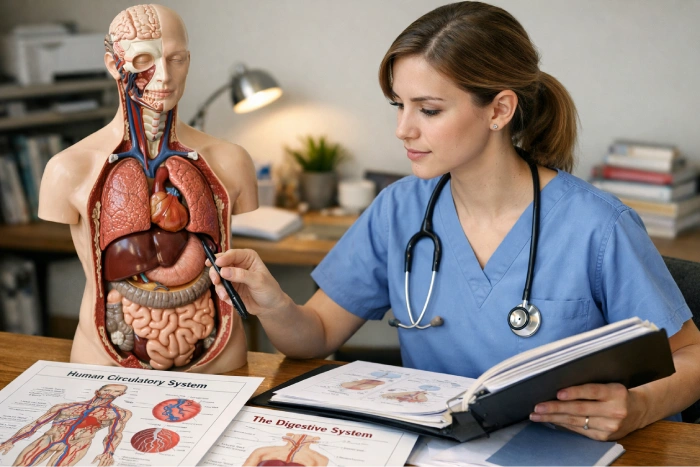
The HESI A2 anatomy part focuses on the various body systems, terminology, tissues, and simple cell processes. But a lot of students study familiar subjects and miss out on key subjects. This HESI A2 anatomy review does just that—covers the key structures, functions, and connections needed in the syllabus. The material of anatomy and physiology can be a bit intimidating, as it is quite wide and may not be difficult for every topic. There is not much time, and you must have a focused approach that takes a look at the concepts that you review often, but does not overlook smaller systems. Take a quick look at every study list names for an overview and use this guide to get ready for the A&P portion in-depth.
What the Section Covers
This HESI A2 section covers anatomy/body language, histology, mitosis, meiosis, and some of the large systems of the body. The terms covered here are important for the study of the human body systems: Directional terms, Body cavities, Anatomical planes, Medical prefixes and suffixes. The epithelial, connective, muscle, and nervous tissues are covered in histology.
Integumentary, skeletal, muscular, nervous, endocrine, cardiovascular, lymphatic and immune, respiratory, digestive, urinary and reproductive systems. Special senses, especially eyes and ears, also require attention.
There are a number of differing sources of publication regarding the number and time of questions in the HESI A2 anatomy section – on average around 25 minutes – with 25 or 30 being raised. The practical limit for this is 50 seconds/question, because that’s 30 questions in 25 minutes. The setup of your exam is dependent upon your program configuration, so check with them which sections you need to take. Terminology and histology are useful, since there are more points when the material is known, which is relatively easily accessible.
The Systems Most Students Skip
There are some body systems that are not studied as much in the sample lists, but each one of these warrants a thorough examination.
- Integumentary: Understand the epidermis, dermis, skin accessories, and temperature regulation. Recall the way in which sweating is used to cool the body.
- Urinary: Study nephron function, filtration and reabsorption, formation of urine, and fluid and electrolyte balance. Know how the kidneys help to control blood pressure.
- Reproductive: Learn to recognize male and female parts, know the menstrual cycle, and understand that fertilization typically takes place in the uterus.
- Lymphatic and immune: Understand the flow of lymph, function of the spleen and thymus glands, and innate and adaptive immunity.
- Special senses: Discuss retina, optic nerve, cochlea, and structures involved with balance.
Sometimes, the integumentary system and urinary system don’t seem to be of as much importance as the heart or lungs, but this is an unnecessary omission of content in HESI A2 anatomy. It could be easier to identify unfamiliar questions if it’s a short, focused session for each.
Tier 1 — Review These First
There are no official weights for the questions on a per-system basis. The priorities are indicative of HESI A2 topics typically prepared for and the potential difficulty of learning fundamental facts.
- Cardiovascular: Research the physiology of heart chambers, heart valves, blood components, and circulation. Understand the flow of blood in the heart and lungs.
- Respiratory: Discuss the air pathway, mechanics of breathing, and gas exchange at the alveoli.
- Nervous: Differentiate between the central and Peripheral nervous system. Refresh knowledge about the structure of the brain, how signals are transmitted, and the main areas of the brain.
- Endocrine: Identify endocrine glands, hormones, and their function. Insulin, for instance, brings down the level of glucose in the blood.
- Terminology: Learn directionality terms, planes of the body systems, and body cavities.
These priorities are only a guideline for HESI A2 anatomy preparation, and should not be considered the official exam weighting. If you want to recall each structure with its function, then connect them both.
Tier 2 — Worth a Single Pass
Review the other body systems topics in an in-depth manner, not memorizing all the details.
- Skeletal: Axial and appendicular skeletons and major bones of the skeleton and types of joints.
- Muscular: 3 types of muscle and main groups of muscles, and basic muscle contraction.
- Digestive: Order of the digestive tract, function of the digestive tract, and digestive tract accessory organs.
- Histology: 4 types of tissues and where they are found.
- Cell division: Mitosis and Meiosis – their difference, purpose, and results.
One function and important structures are to be identified for each topic. This will ensure that the anatomy and physiology review is suitable for an admissions assessment.
The Cross-System Questions
Many of the practice questions test a relationship and not individual facts. Carefully examine the following body systems relationships:
- Respiratory and cardiovascular: exchange of gases in the lungs and transport of oxygen to tissue by blood.
- Cardiovascular: kidneys filter blood and aid in balance and blood pressure.
- Nervous and muscular: The nerve releases signals that stimulate the contraction of the muscles by the neuromuscular junctions.
- Endocrine and reproductive: The hormones control functions of reproduction and menstruation.
- Cardiovascular and digestive: Absorbed nutrients go into the bloodstream and to the cells in the body.
During HESI A2 anatomy review questions, ask questions about how each of the systems helps each other. For instance, blood pressure is controlled by the kidneys, and blood is brought to it for filtration by the circulatory system. Knowing these relationships will help you solidify your knowledge of physiology and help you with the next step: application questions.
What Physiology Means Here
Physiology at this level is the understanding of normal anatomy and physiology functions and homeostasis. Emphasis on function of structures, the role of organs, and maintenance of balance in systems. Usually, the details of disease mechanisms and clinical management are less important than normal structure and function.
If you have limited time, practice repeated retrieval; do not re-read chapters. Close your HESI A2 notes, remember structures, describe the purpose of each structure, and review answers. This can be helpful to accelerate recognition.
A Three-Day Review Order
Then the honest caveat: this assumes you have already covered the material once. It is a review order, not a first-pass study plan.
Three days prior: Go over terminology, histology, and your two weakest body systems. Become familiar with directional terms without the aid of notes.
Two days before: Link together the cardiovascular, respiratory, urinary, nervous, muscular, endocrine, and reproductive systems with brief practice questions.
Review integumentary, urinary, reproductive, and lymphatic systems one day before. Complete with HESI A2 anatomy retrieval activities rather than lots of new content.
This is a schedule assuming that the material has been studied once already. Make it challenging to your weakest parts and your time available to prepare.
Frequently Asked Questions
How many questions are on the HESI A2 anatomy section?
There are varying numbers of questions with about 25 minutes, depending on the published figures from the preps. Make 30 in 25 minutes and verify your nursing program’s HESI A2.
Is the urinary system on the HESI A2?
Yes. Important topics include nephron function, filtration, reabsorption, and urine formation. One of the body systems that students must study before test day is the urinary system.
Does the HESI A2 test pathophysiology?
Mostly no. Emphasis is placed on the normal structure and function at an introductory level. A general knowledge of the physiology and basic anatomy and physiology is more useful than knowledge of detailed disease mechanisms.
What should I study first for HESI A2 anatomy?
Use terminology and directional terms that are easily recalled. Next, review topics on cardiovascular, respiratory, nervous, and endocrine systems first, then go over the systems that are commonly not covered in HESI A2 anatomy.
Conclusion
Reviewing the topics missed, linking body systems, and working with normal physiology are the key aspects of preparing for HESI A2 anatomy, not just reading notes over and over again. Use the extra time wisely and rigorously focus on key concepts. If you would like more tips and advice, check out HESI exam tutoring services.