
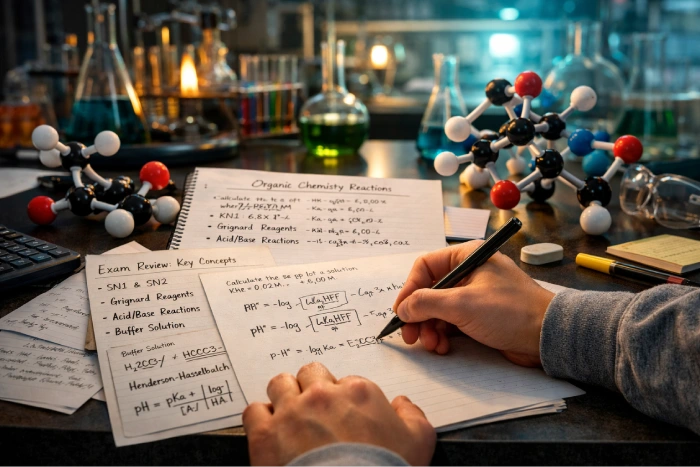
The HESI A2 chemistry section is about 25 questions in roughly 25 minutes, covering atomic structure, the periodic table, bonding, reactions, solutions, and acids and bases. Not every nursing program requires this section — check yours first. This HESI A2 chemistry study guide covers every topic, the formulas to memorize, and free practice questions.
See our section-by-section HESI breakdown for the full exam picture.
Do You Even Need the HESI Chemistry Section?
The HESI A2 is a test that contains 8 academic subtests, but the majority of nursing programs require only 4 to 6. The HESI A2 is 1 of 8 academic subtests, while most nursing programs only require 4 to 6. Rarely will Chemistry be required unless it is a prerequisite course for that program.
So what chemistry is on the HESI A2 for you, specifically? Please ensure that you refer to your program’s admissions page, and then when you put in your school code on the Evolve registration screen, it will only list your program’s selected sections.
Please note: It is important to register for the correct sections, as it is possible to be assigned to take the same exam again for the same section if you register for the wrong one. Review all HESI A2 sections and question types (and the difference between optional vs. required sections in a full breakdown).
HESI A2 Chemistry Section Format
Before tackling topics and formulas, it’s useful to understand exactly how the section will appear on test day: how many questions will be on the test, how much time you’ll have, and if you’ll have a calculator or not. Here’s the quick breakdown:
| Detail | What to expect |
| Number of questions | 25, plus a few unscored pilot items |
| Time limit | About 25 minutes |
| Question format | Multiple choice |
| Calculator | Basic on-screen calculator available |
| Typical minimum score | Most programs want 75%–80%, some 85% |
Sources list slightly different timings for HESI a2 chemistry, so treat this as a planning guide. The exact limit will show on your screen on test day.
All HESI A2 Chemistry Topics (High-Yield vs Low-Yield)
Some topics are more important than others on the paper, and there are limited questions, meaning that some are worth more of your study time than others. The full list of chemistry topics for the HESI A2 chemistry topics, are listed below with High Priority, Medium Priority, and Low Priority to help you see at a glance where to start:
| Topic | What’s Tested | Priority |
| Matter and states of matter | Solid, liquid, gas, phase changes | High |
| Atomic structure | Protons, neutrons, electrons, isotopes, atomic number vs. mass | High |
| Periodic table and trends | Groups, periods, metals vs. nonmetals | High |
| Chemical bonding | Ionic, covalent, polar covalent, hydrogen bonds | High |
| Chemical equations and reaction types | Synthesis, decomposition, replacement, combustion, balancing | High |
| Acids, bases and pH | The 0–14 scale | High |
| Solutions and molarity | Solute, solvent, concentration, dilution | Medium |
| Stoichiometry and the mole | Mole ratios, converting to grams | Medium |
| Oxidation-reduction | Basic redox reactions | Medium |
| Scientific notation and metric conversions | Powers of ten, unit conversions | Medium |
| Nuclear chemistry | Half-life, radiation types | Low |
| Biochemistry | Carbs, lipids, proteins, nucleic acids | Low |
With only 25 questions, you’re looking at roughly 1–2 per topic, so the “High” rows are where most marks live. Bonus: those HESI a2 chemistry topics overlap with the HESI A2 biology topics tested, so studying them pays twice.
HESI Chemistry Formulas You Must Memorize
Chemistry on the HESI A2 is more concept-based than math-based, but there are a few calculations sprinkled throughout, and you must be able to recite them from memory. There will be no formula sheet, which means these HESI chemistry formulas must be memorized before the test, not during!
| Formula | What It Solves | Quick Example |
| D = m / V | Density | 20g in 4mL $\rightarrow$ 5 g/mL |
| M = mol solute ÷ L solution | Molarity | 2 mol in 1L $\rightarrow$ 2M |
| M₁V₁ = M₂V₂ | Dilution | Diluting a stock solution |
| Moles $\leftrightarrow$ Grams | Uses molar mass | $\text{Grams} \div \text{molar mass}$ |
| Avogadro’s number | Particles per mole | $6.022 \times 10^{23}$ |
| Percent composition | Element mass $\div$ total mass $\times 100$ | % oxygen in water |
| pH = −log[H⁺] | Acid/base strength | Below 7 acidic, above 7 basic |
| °C ↔ °F ↔ K | Temperature conversion | $^\circ\text{F} = (^\circ\text{C} \times \frac{9}{5}) + 32$ |
| Metric prefixes | Kilo, centi, milli, micro | 1 kg = 1,000 g |
The majority of chemistry questions are concept-first, with a small amount of math; unit errors result in more marks being lost than the actual calculations. See the math on the HESI A2 exam for the broader skill set.
HESI A2 Chemistry Practice Questions (With Answers)
Five original HESI a2 questions, each covering one of the major topics:
- Structure of an atom — There are 17 protons and 18 neutrons in an atom. Its mass number? A) 17 B) 18 C) 35 D) 1 Answer: C. Mass number = protons + neutrons (17+18=35); atomic number counts protons only.
- Chemical Bonding — Which type of bond involves sharing of electrons between two nonmetals?
- A) Ionic B) Covalent C) Metallic D) Hydrogen Answer: B) Covalent bonds share an electron pair; an ionic bond transfers an electron.
- Balancing Equations — Balance: __H₂ + __O₂ → __H₂O A) 1,1,1 B) 2,1,2 C) 2,2,1 D)
2H₂ + O₂ → 2H₂O balances 4 hydrogen and 2 oxygen atoms per side.
- pH — A solution has pH 3. What does this imply?
- A) Strongly basic B) Neutral C) Acidic D) No H+ ions Answer: C) Acidic; the closer to zero, the stronger the acid.
- Molarity/Dilution — Dilute 2L of 4M solution to 8L. New molarity?
- A) 1M B) 2M C) 4M D) 8M Answer: A. M₁V₁=M₂V₂: (4)(2)=M₂(8), so M₂=1M — four times weaker.
Try more at our free HESI practice tests worth using, then learn how to review your practice test results properly after any HESI A2 chemistry practice test.
7-Day HESI Chemistry Study Plan
- Day 1–2: Atomic structure, periodic table, bonding.
- Day 3: Reaction types and balancing equations.
- Day 4: Acids, bases, pH, solutions and molarity.
- Day 5: Formulas, metric conversions, scientific notation.
- Day 6: Full practice set under timed conditions.
- Day 7: Review only the questions you missed.
Limiting the daily reading to 45-60 minutes; most readers are studying around a job. For a more comprehensive HESI A2 chemistry study guide, check out how to improve your HESI A2 score in two weeks, and look through the best HESI prep books that teach all of the HESI A2 chemistry topics listed above.
Frequently Asked Questions
What chemistry topics are on the HESI A2?
Atomic structure, periodic table, types of bonding, types of reactions, acids/bases and pH, solutions, stoichiometry, light, biochemistry.
How many questions are on the HESI chemistry section?
Around 25 scored questions in about 25 minutes, plus a few unscored pilot items. Your screen confirms the exact count.
Do I need chemistry for the HESI A2?
Not always — some programs require it, usually when general chemistry is also a course prerequisite. Check your admissions page.
Is HESI chemistry hard?
Whether HESI chemistry is hard depends on your background — content stays intro-level, so most difficulty comes from rusty basics, not advanced material.
How long should I study for HESI chemistry?
It typically takes 45-60 minutes a day over a focused 7-day period. Include days for HESI a2 chemistry practice tests in areas of weakness.
Take a look at the the hardest sections of the HESI exam and make comparisons with chemistry.
Conclusion
HESI a2 chemistry is not such a daunting subject when you know where you’re getting the points from. Focus on the high-priority topics (atomic structure, bonding, reactions, and pH) and keep the formula list handy — no formula sheet will be given on test day. Complete the above practice questions and then use the 7-day plan to build your strengths, identifying any weaknesses along the way. In most of this section, consistency is the key to success, rather than cramming, so a few minutes a day will help more. For additional support preparing a plan for your schedule, get in touch we will help you.