
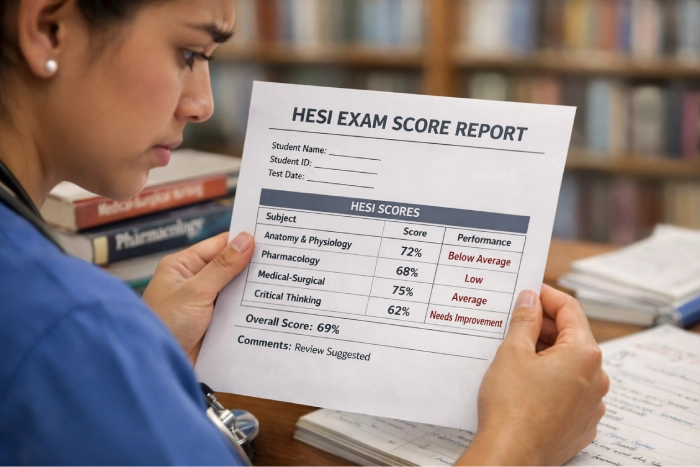
What is a good HESI score? Most of the nursing colleges set a standard passing HESI score of 75%, but it is not what it looks like. To get admission in a good institute, a higher and competitive score of 80-95% is required. Many students think that getting 75% is enough to get nursing admission, but getting the passing marks is just like making it to the hall; to get on the stage, competitive scores are required. There is a major difference between a “passing” score and a “competitive” score, about which most of the applicants are unaware.
Before attempting the test, there is a misconception that “passing” is enough; once you get in the field, you’ve got to know that competition is so fierce. Every college sets its own benchmark of “competitive scores,” and there is no universal passing score. However, to get admission in a prestigious nursing college, you must know “what is the HESI exam”, and how many marks above 75% can help you get into your dream nursing college.
HESI Score Range & What Does Each Score Mean?
The HESI score range gives a realistic picture of where the students stand during the admission process. Understanding the HESI score range is important because many times students wrongly assume that every passing mark carries the same weight. In reality, nursing schools evaluate students based on their performance, especially when seats are limited. A score that seems okay at one institute can be lower at another competitive BSN program.
Here is a precise table of the HESI score range that will help you understand what each score means:
| HESI Score | Meaning | Competitiveness |
| Below 70% | Failing | Most programs reject the application |
| 75-79% | Minimum Pass | Accepted mainly in less competitive programs |
| 80-84% | Average | Common for many AND programs |
| 85-89% | Good | Competitive for many BSN programs |
| 90%+ | Excellent | Strong for top-tier BSN and accelerated programs |
Students should also have to understand the percentile rank, as it compares their performance against other test-takers rather than just looking at their percentage. For instance, 85% may look great on the result sheet, but if most of the candidates have achieved 90%+ scores, your chances of getting into a good nursing program are decreased. For this, instead of just focusing on the passing scores, students should focus on getting competitive marks for their target schools. If you want to get top-tier marks to get into your dream nursing school, you must know how to score 90 in HESI A2.
What is the Minimum HESI Score for Nursing Programs?
The minimum HESI score, required for admission totally depends on the program you want to get enrolled in and the pathway you choose. Because every nursing program has a varied level of academic challenge and competition, different prerequisites lead to varying expectations. According to the complete 2026 HESI guide, compared to BSN or accelerated nursing schools, LPN programs typically accept lower scores. While ADN programs often need scores between 75 and 85 percent, the majority of LPN institutions allow students who score between 70 and 75 percent.
BSN programs are usually more competitive because they attract a larger number of applicants and often offer better long-term career opportunities. Students with scores between 80 and 90% are preferred by many BSN schools, particularly in the reading and science portions. The most common error made by candidates is to confuse a guaranteed admission score with the minimum HESI score. The minimum does not indicate the score that truly makes your application good enough to stand out; rather, it just indicates the lowest permissible score.
Instead of depending solely on stated nursing program requirements, students should continually compare their scores to those of the competitors. Although a school may formally accept 75%, it becomes dangerous to aim for the minimum if the majority of accepted students score higher than 85%.
Understanding Your HESI Composite Scores
Your HESI composite score is the combined average of all the tested sections, and many nursing schools use these scores to evaluate applicants. However, pupils frequently have misconceptions about the scoring method. Weak section scores might still cause issues during the admissions process, even if your total average appears excellent. For instance, a student may do badly in Anatomy & Physiology yet excel in Reading and Vocabulary. Regardless of the overall composite, several institutions expressly require minimum science section scores, even though the final average may still seem competitive.
For this reason, rather than concentrating just on the average, students should pay special attention to their individual section results. Because many nursing schools use science achievement as a predictor of future academic success in nursing courses, anatomy and physiology are particularly crucial. A weak science section questions whether the students can handle complex nursing theories.
It is frequently safer to first review HESI difficulty by section and then have a balanced performance across all portions rather than one very high section and one very poor area. Instead of focusing just on raising the total average, smart preparation includes recognizing weaker areas early on and strengthening them before exam day, to get a top-tier HESI composite score.
Is a 75% HESI Passing Score Good Enough?
A typical HESI passing score may fulfil the eligibility criteria of most nursing schools, but it doesn’t make an applicant competitive enough. Many students get confused at this point because they think that simply “passing” shows that they have a good chance of getting admission in their desired nursing program. In reality, nursing schools evaluate candidates not only against the basic requirements but also against each other. Students get hesi passing score are in direct competition with those who score 85%, 90%, or even higher.
Imagining a job interview is the easiest way to comprehend this. Employers still select the best applicant; fulfilling the requirements for a position does not ensure that you will be employed. A similar procedure is used in nursing schools. Candidates with competitive score, often gain preference during selection, but a 75% may help you qualify for consideration. Therefore, you should always look for how you can improve your HESI score in 2 weeks, if you are really dedicated to getting into your dream college.
What if Your HESI Score is Too Low? (Retake Rules)
Getting a low HESI score is quite disappointing, but it is not the end. The majority of institutions permit students to attempt HESI retake, providing them with an additional chance to enhance their performance and bolster their applications. However, every institution follows different retake rules, so students should always review their school’s HESI A2 retake policy, attempt limits, and waiting periods.
Schools typically mandate a 60-day waiting period before allowing students to retake an exam. Additionally, some programs restrict candidates to two or three attempts in a single year. If students make good use of the additional time by concentrating on their weak areas, honing their test-taking techniques, and practicing under time constraints, a retake of the HESI can really work to their advantage. Because they are already familiar with the framework of the test and the typical question types, many students do noticeably better on their second try.
It’s crucial to prepare well before taking another test. Rather, students should determine which are the most difficult sections to retake and which portions resulted in the largest decline in score, and deliberately address them.
How to Boost a Low HESI Score Before Retaking?
The best way to boost HESI score is to study strategically instead of spending long hours reviewing every day equally. Many students are unable to improve because they are unable to pinpoint the precise areas that are producing their poor marks. Examine your previous scores carefully before retaking the test to find out where you lost the most points. Was it reading comprehension, math, or anatomy and physiology? The first step in creating a successful study plan is identifying your areas of weakness.
After determining which subject is your weakest, devote about 80% of your preparation time to strengthening that area rather than going over things you already know. Always remember the most effective strategy is to study smarter, not harder. Students may raise their scores more quickly and effectively if they follow a strategic approach.
Additionally, as many students struggle more with test pressure and speed than with knowledge, it is crucial to take timed practice examinations before the retake and analyze your practice test results.
Conclusion: What Scores Should You Actually Aim for?
So, what is a good HESI score in 2026? While many schools list 75% as the minimum requirement, students should not aim for the bare minimum if they want stronger admission chances. A score of 85% or higher is much safer and far more competitive for BSN and accelerated nursing programs. Higher scores help students stand out against other students competing for limited seats.
Instead of guessing whether your score is good enough, start with a full-length practice test to identify your weak areas and get to know which sections you have to focus on more. You must know why practice exams are crucial to get a competitive score instead of just a passing score in order to achieve your nursing goals.