
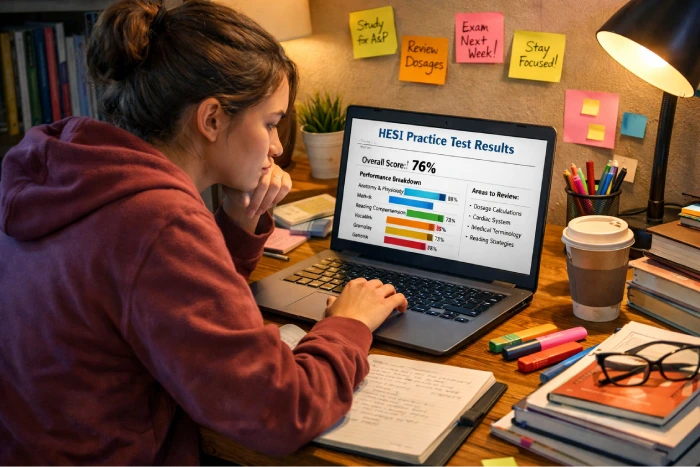
One of the main errors that the students commit is that they will take a HESI practice test, get a final score of 72%, and become emotional, then they jump to another test. It is a productive way to go, and it seldom results in actual improvement. The only use of a practice score is that it must alter the next action. Similarly, to check your weight without modifying your lifestyle, you cannot grow by taking the test again without going through the process.
The most intelligent method of HESI practice test analysis is to dedicate as much time as you have to taking the exam. It is the quickest method to detect trends, seal weak spots, and improve HESI score statistics before the actual test. It is precisely because learning the reasons as to why the practice exam is crucial, should you want to pass the HESI exam with confidence.
Step 1: categorize Your Errors (The “Why” Matrix)
Not all wrong answers imply the same thing. To ensure your HESI exam results are better, you first need to name each error that occurred.
With this rudimentary HESI score breakdown structure:
-
Content Gap
You really were not aware of the idea.
Fix: Retudy the subject.
-
Misreading
You omitted such words as NOT, EXCEPT, or misread the question posed.
Fix: Underline and circle keywords.
-
Careless Math
You were aware of the procedure but had a hitch in the calculations.
Fix: Revise arithmetic.
-
Guessing
You did not have any real plan and chose arbitrarily.
Fix: Be it a content weakness.
This structure would be particularly effective in the case of diagnosing common mistakes in HESI math, as students tend to mix up a conceptual error with a mere error in calculation.
Step 2: Analyzing Section-Specific Weaknesses
Spotting patterns of topics in sections is the next level of HESI practice test analysis.
Use this checklist:
-
Math:
Divisions, proportions, percentages, conversions, and calculations of dose.
-
Reading:
Primary point, emphasis, conclusion, intent of the author.
-
Anatomy & Physiology:
Endocrine, cardiovascular, nervous, and digestive systems
-
Grammar:
Construction of the sentence, punctuation, and agreement of verbs.
It is not to say that I am not good at math. Instead, say:
- 5 question(s) of fraction questions missed.
- Inference: This is my area of weakness in reading.
- “My anatomy score continues to reduce due to the endocrine system.
That degree of detail can assist in decoding sections and a narrow-minded HESI anatomy breakdown plan.
Step 3: Reviewing Correct Answers (The Hidden Trap)
It is here that most of the students end up developing a misguided sense of confidence.
There are instances when you may pick the right answer, and this is just because of chance. Unless you go through those questions, you might think that you have mastered the topic when you have not.
To improve your HESI score, you have to go through each of the questions that you have marked:
- Unsure
- 50/50
- Educated guess
- Pure instinct
Then ask:
- Why was the correct option right?
- Why were the other three mistaken?
- Could I do it tomorrow?
This is among the strongest types of active learning since it transforms the mere fortuitous victories into actual knowledge.
Step 4: Time Management Audit
The majority of online practice sites follow the amount of time you spend on a given question, and this information is invaluable.
Time vampires: When going over your HESI exam results, you can look at them searching:
- Questions that require more than 2-4 minutes.
- Repeated re-reading
- Difficult math setups
- Long reading passages
Also, examine the final questions of each part (5 to 10). When the majority of those are inaccurate, it may not be anything about content–it can be pacing.
Take this fast timing audit:
- What type of question was the most slowing to me?
- Were any of my hard problems too long?
- Were there any impacts on the final section due to rushing?
This simplifies a great deal learning how to strategically manage time rather than doing it emotionally.
Step 5: Creating a Remediation Plan
After you have your HESI score breakdown, you will need to move on to targeted repair.
Construct an elementary correction plan:
- Gap in content → Reread a topic video or reread the chapter.
- Misreading → Exercising stem keywords.
- Careless Math → Slowing of calculation exercises.
- Guessing → Recreate before retesting
This is the most significant rule of the HESI practice test analysis:
One should not go through another full practice test unless the very weak areas are taken care of.
This is why intentional study strategies would be much more important than the arbitrary repetition, particularly when your goal is to have a score of 90 in HESI A2.
Tracking Your Progress Over Time
When you record your progress in a notebook or spreadsheet, your progress becomes a lot more apparent.
Use columns like:
- Date
- Overall Score
- Section Score
- Top 3 Weak Topics
- Time Problem Areas
That is not the only thing you want to achieve. And it is to watch your feeble subjects develop.
For example:
- Test 1 → Fractions
- Test 2 → Fractions
- Test 3 → Fractions
When the same weakness is manifested more than once, then your approach must be changed. This type of tracking system is particularly helpful when balancing nursing school work and trying to improve HESI score, as it helps you to focus your limited study time.
An error journal is one of the best means of reinforcing your review process by establishing an error journal at the end of each practice test. Rather than how many you missed, write down the actual type of question, the reason why you missed it, and what you will change next time. This makes passive review a repeat correction system.
A basic error journal may consist of:
- Topics of the questions: Fractions, endocrine system, inference.
- Reason of mistake: Misread, guessed, or a content gap.
- Proper strategy: Reduce your speed, reread the formula, and re-read the concept.
- Retest date: Again attempt in 48 hours.
The approach allows you to make future practice test analysis of HESI much more fruitful since it will demonstrate whether you are actually reducing your errors or continue to do so under a different guise.
Conclusion: Data is Your Best Friend
A practice test is not an evaluation of your level of intelligence- it is a diagnostic report. Your HESI exam results can be used best to:
- Categorize errors
- Review lucky guesses
- Audit pacing
- Repair the exact weak areas
- Track recurring patterns
This entire HESI practice test analysis turns errors into score improvements. Any incorrect response that you practice today is one of the mistakes that you will avoid on the exam day.
Then, rather than being afraid of low scores, take direction. Test data can be your best study companion when it is utilized properly- it can be even more valuable than wondering how much is the cost of HESI preparation or is the HESI exam is hard.